
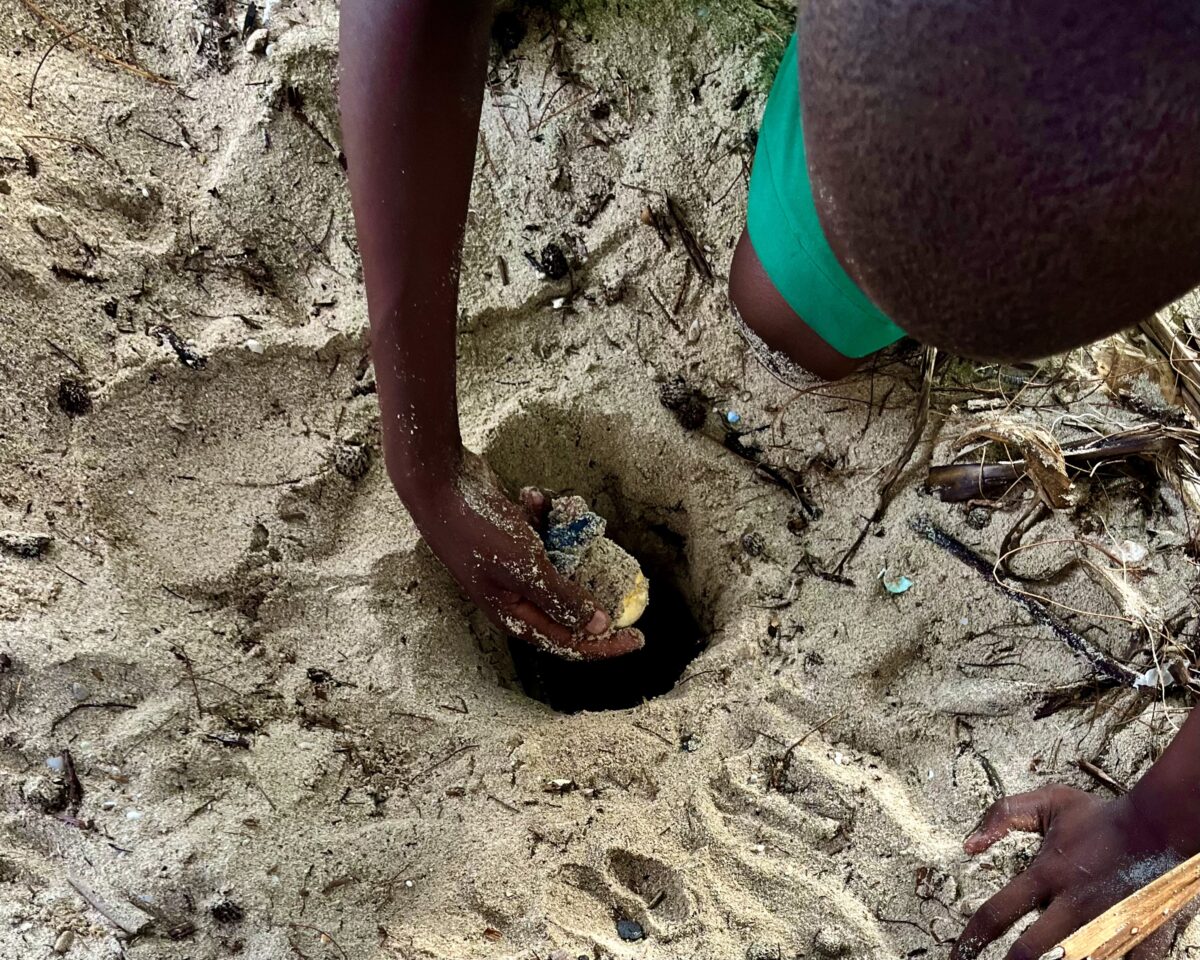
On a white sand beach, a boy digs a hole high up on the bank. The beach lies in a cove surrounded by coral walls, fronted by the Indian Ocean, and topped by towering palms. An idyllic location just north of the major port city of Mombasa, but there’s evidence of humankind all around. A row of huge houses sits a hundred metres from shore; a popular restaurant disgorges boozy customers into the sand. Among the palm fronds and scattered shells are washed-up flip-flops, pieces of plastic and smashed glass in the sand. The boy scoops another handful of sand and I spy a small wriggling shape, just a couple of inches long, the tiniest newly hatched turtle. Soon he is removing hatchlings by the handful. For these babies, the human diestrus is just one of many challenges they will have in their journey to adulthood, and only 1 in 1000 turtles will reach full maturity.

Roger Jessop checks each turtle as it is handed to him. This nest is abundant, with 121 turtles, all alive and healthy.
‘Look’, he says, showing me the hatchling’s undersides. It looks to me like lumps of seaweed are attached to the baby’s belly. ‘These are the yolks yet to be fully absorbed’.
Roger places the hatchlings into two buckets, those that can be released now, and those that need more time. The premature turtles he will bring to his house, where he will care for them until they are well enough to be released.
The healthy turtles are walked a few yards closer to the beach. Roger explains that the turtles must journey from the nest to the beach themselves. Every female turtle has that journey imprinted in her, and ten years later, she uses the earth magnetic fields to return to the same beach to lay her nest of eggs. The short distance that Roger carries these infant turtles, wont affect the turtles ability to return home but it will save lives. Human traffic is just one of many dangers these turtles can expect. In the frangipani trees and coconut palms that line the beach are countless crows, greedily eyeing the turtles. Ghost crabs linger nearby; even the smallest of crabs will take a turtle to eat. On the beach, dogs run, people jog, and mongoose and rats hide in the bushes. Human settlements nearby can confuse the the hatchlings who are headed for the ocean. Turtles use the natural light horizon and the white crests of waves to guide themselves to the water. If they hatch at night, the light from the nearby houses can disorientate them, causing them to move away from the ocean rather than to it. The journey to the beach is hazardous, and Roger is here for every single hatching.
The turtles are gently tipped from the bucket and head for the ocean in a surprising frenzy. Within seconds, they had traversed the 5 metres of sand and disappeared beneath the waves. One small turtle heads off in the wrong direction but is carefully turned around. Three more nests are released today, approximately 300 turtles in total.
Once in the ocean, hatchlings are fair game for large fish and are often caught by fishermen or die through ingesting plastic or tar balls. Turtle Watch in Watamu state that 62% of turtles admitted to their ‘turtle hospital’ for rehabilitation have been injured due to human-related causes. The increased tourism in Kenya means more boats, pollution and damage to the turtle’s natural environment.
Roger, who runs Jumba Turtles on Mtwapa Beach, is just one of many volunteers along the Kenyan Coast to dedicate his time to saving turtles. He does all he can but is aware that it may not be enough.
‘A fisherman told me he opened the belly of a dorado, and it was full of baby turtles.’ Roger tells me, looking distraught, ‘These turtles are like my children. I wish I could do more.’ Where there are humans, there is kindness, I think, marvelling at the time and dedication Roger gives to these endangered animals. With education and the perseverance of people like Roger, there is hope for these Kenya turtles.
Kenya Turtles Conservation
Many turtle organisations in Kenya are doing invaluable work. In addition to turtle nest monitoring and catch & release, they will work with local communities and fishermen to educate them on the importance of turtle conservation. Some take sick and injured turtles and rehabilitate them. Some will focus on preserving the local environment and conserving mangrove plantations, beaches, and reefs.

Where to see Kenya Turtles
If you would like to watch turtles being released, many turtle beaches throughout Kenya exist. It is always advisable to contact the local organisation to find out when the nests are due to hatch. Never dig into a nest. Some organisations like Turtle Watch in Watamu and Diani Beach encourage you to visit and learn about their conservation work. Turtle Watch often have turtles in the house which are being rehabilitated, so you may have the opportunity to see a mature turtle up close.
WWF Kenya – Turtle Conservation
Bahari Hai – Watamu
Local Ocean Co/Turtle Rescue – Watamu & Diani

Turtles Kenya – Facts
- There are five species of turtles in the world: the green turtle (Chelonia mydas), hawksbill turtle (Eretmochelys imbricata), loggerhead turtle (Caretta caretta), olive ridley turtle (Lepidochelys olivacea) and the leatherback turtle (Dermochelys coriacea). Kenya turtles include the green, hawksbill and olive ridley turtles.
- There is currently no legislation protecting critical nesting and foraging habitats utilised by Kenya turtles except for those falling within Marine Protected Areas (MPAs), which means poaching of turtles is rife.
- The world’s population of turtles has decreased by 80% over the last 50 years.
- One 1 in 1000 turtles will make it to adulthood.
- Kenya Turtles natural predators include crabs, birds, racoons, and fish. They are endangered because of the loss of natural habitat – human encroachment on traditional breeding and feeding grounds, and water pollution, plastic, oil and other debris.
Further Reading
Eco Travel Africa – 12 Conservation Friendly Adventures
Kilifi Kenya – The Ultimate Holiday Guide
Book Your Kenya Trip – Insider Tips
Find everything you need for visiting Kenya on my TRAVEL RESOURCES page.
Find everything you need for moving to Kenya in my THE EXPAT GUIDE TO LIVING IN NAIROBI book.
- Kenya Accommodation: Booking.com has the cheapest rates for hotels and guest houses in Kenya.
- Accommodation Reviews: TripAdvisor is my go-to portal for checking reviews on accommodation/restaurants in the local area. I never book without checking TripAdvisor first.
- ESIM: Airalo allows you to access the Internet from virtually any country without paying roaming charges
- Car Rental: Rental Cars is managed by Booking.com – guaranteed reliable.
- Tours and Guides in Kenya : Check out Get Your Guide and Viator – reputable companies that do tours within Kenya and East Africa.
- Travel Insurance: Travel insurance will protect you against illness, injury, theft, and cancellations. I recommend Visitors Coverage, which covers you for East Africa and offers ‘special insurance’ for safaris and adventure sports:
- Visitors Coverage
- Compensair – if you have a cancelled or delayed flight, you may get a refund.
Your article is well explained, thanks for sharing.