
Meru National Park sits to the east of Mount Kenya. This Kenyan safari park is known as one of the most beautiful wildlife parks in the country. Affectionately known as Kenya’s wilderness, Meru is way off the beaten track for most visitors.
Meru is hectares of white grass, tropical rainforest, swamps, and desert-like landscapes intersected by 13 rivers. Towering doum palms and baobab trees reach for the sky, silhouetted against the ever-present Nyambeni Hills.

Meru National Park is only 350 miles from Nairobi but the journey through farmland, small villages and along the foothills of Mount Kenya took us 8 hours. Meru’s remoteness and absence of tourists are all part of its allure.
Meru National Park is part of a 5000 sq km ecosystem that includes Kora, Bisandi, North Kitui and Rahole Reserves. Meru itself is over 870 sq km of wilderness that ranges from 3400ft high forests to deserts, peppered with candelabra trees. On its western edge lie the Nyambeni Hills, which provide water for the maze of rivers that crisscross the park. It is this abundance of water in an arid and predominantly low-lying area of Kenya that makes Meru so special and its wildlife so prolific and diverse.

Meru National Park Facts:
- Meru is famously immortalized in the best-selling book and movie Born Free. The story of George and Joy Adamson who raised an orphaned lioness, Elsa, as their own. The movie is a great watch for an accurate description of the beauty of Meru National Park.
- The longest river in Kenya, the Tana River, which spans some 1000 kilometres, runs through Meru National Park. The 13 rivers and various tributaries are fed from water from nearby Mount Kenya and the Nyambeni Hills, and flow into the Tana River.
- Meru National Park has a dark past. During the 1980s, the park was overrun with poachers who annihilated the White Rhino population. The Kenyan Government responded with force, driving out poachers and ramping up security. Today wildlife numbers are soaring and the Rhino sanctuary.
- Meru has some of the largest herds of buffalo in Kenya.
- Meru National Park is home to over 400 species of bird life

Wildlife at Meru National Park
All the African Big 5 live within the Meru National Park. On our trip to Meru we saw 3. There were many elephants, although not in vast herds, like Amboseli. We encountered 16 rhinos within the sanctuary and some large buffalo herds. Meru National Park is home to all the cats, lion, leopard, cheetah, serval, caracal, genet and civet. We saw several genet, but the big cats are harder to spot in Meru as the vegetation is very high.
My favourite giraffe, the reticulated giraffe, were out in huge numbers. Three times we saw groups of around 20 running through the savannah. It was an awe-inspiring sight.
Other wildlife within Meru National Park includes hippo, the endangered Grevy’s zebra, hyena, wild dog, oryx, gerenuk, jackals, wild dog, honey badgers, otters, mongoose, pangolin, python, puff adders, cobra and all the usual plains animals.
I’m not a birder but Meru is famed for its bird life – with 427 species recorded. For those in the know, you can see Pels Fishing Owl, one of the largest owl species in the world, White-eared Barbet, Black and White Flycatcher, African Finfoot, Hinde’s Babbler, Black-headed Lapwing and Quail Plover.

The Rhino Sanctuary at Meru National Park
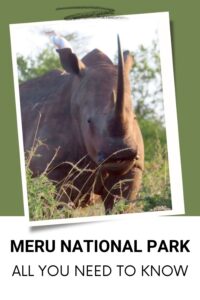
50 square kilometres of land within Meru National Park is given to the Rhino Sanctuary. The sanctuary is fenced off from the rest of the park by an electric fence and is home to 40 white rhinos and 20 black rhinos. I am told it’s hard to find the rhino within the park, but we spotted 16 in a relatively short time. The Rhino Sanctuary at Meru has the best rhino birth rate and less death than any other sanctuary in Kenya. A roaring success considering the park’s chequered past.

Meru National Park Attractions
Attractions within Meru National Park include the Rhino Sanctuary, as above. A visit to the Tana River, viewing the burial sites of Joy Adamson and Elsa the lioness, and the chance to experience Adamson’s Falls.
You can arrange a guided walking tour of Meru National Park, and a community visit to Meru’s Tharaka tribe for a glimpse of how people live in this part of the country.
Where to stay in Meru National Park
Lodges in Meru National Park
Elsa’s Kopjie Meru National Park
The hillocks that hide Elsas Kopje can be seen from miles away, rising above the flat savannah that surrounds it. The lodge is built on Mughwango Hill and the architecture does an excellent job of creating a symbiotic balance between man-made materials and the natural landscape. Cottages are woven into the features of the hillside, meaning you don’t realise there is a 5-star lodge on the mountain until you are right on top of it.
Accommodation is in individual cottages, each with a spacious bedroom, open sitting rooms, ensuite bathroom and wide veranda with breathtaking views of the savannah below. Elsa’s Private House – with double rooms, a sitting room, veranda and plunge pool – is ideal for families.
There is an open bar, an infinity pool, and an excellent restaurant where the chef offers a menu based on Northern Italian cuisines. Game drives, guided nature walks, trips out to the Tana River and bush meals are all par for the course.

Rhino River Camp Meru National Park
Rhino River Camp is just outside Meru National Park, opposite the gate to the Rhino Sanctuary. The camp sits within 60 acres of privately owned wilderness. The small camp has just 7 tents that wind along the Kindani River or nestle under the shade of the indigenous forest. There is a pool, bar and fabulous restaurant onsite and Game drives into the Rhino Sanctuary or beyond into the main park are a must.

Campsites in Meru National Park
Bwatherongai is Meru’s only public campsite, and it’s a sweet spot. There are three separate campsites (No.3 is the most private and shaded). Facilities include cold showers and flushing toilets, a swimming pool, and fire pits and BBQ facilities in each of the three camping spots. The bathrooms are pretty grotty, not dirty, just full of bugs. The staff are friendly and will provide you with enormous wood piles that burn hotter than the sun for 500 bob a day.
We were warned about baboons, but they never came into our camp. The campsite is unfenced, so you need to watch out for predators.
There are 8 private campsites in Meru. We checked out a couple of them. They all appear to have no facilities at all, but you get a fantastic wild camping experience and a guarantee of being alone. These private or Special Campsites must be pre-booked via the KWS website.

Camping fees In Meru National Park
For camping at Bwatherongai Public Campsite, the fees are:
200 KSH / 2.50 USD per adult per day (CITIZEN OR RESIDENT)
150 KSH / 2 USD per child per day
20 USD per adult per day (NON-RESIDENT)
15 USD per child per day
To camp at any of the Special Campsites, the fees are
250 KSH / 2.50 USD per adult per day (CITIZEN OR RESIDENT)
200 KSH / 2 USD per child per day
35 USD per adult per day (NON-RESIDENT)
20 per child per day

Meru National Park Fees
The entrance fee for Meru National Park is:
300 KSH / 3 USD for adult (CITIZEN OR RESIDENT)
200 KSH / 2 USD for children.
For Non RESIDENTS, Meru National Park fees are 52 USD per adult & 35 USD per child
Weather in Meru National Park
The days are warm, with temperatures around 30 deg C and the evenings are cool. Rainfall is mostly in April and May.
Meru National Park Map

How to get to Meru National Park
Meru National park lies 335 kilometres northeast of Nairobi and 60 kilometres east of Meru town. There are two routes to access travellers to Meru, through the main gate known as Murera Gate and through Ura Gate. Both can be accessed by public means or private vehicles.
Meru National Park can be accessed by air or by road transport.
Road route to Meru
- From Nairobi via Embu to Ura Gate –Meru national park is 312 kilometres. Although this looks like the shorter route – the journey via Nanyuki is shorter in time. This route is approximately 8 hours.
- From Nairobi via Nanyuki town to access Meru national park covers a distance of 331 kilometres. The journey took us 7 hours.
Flights to Meru
Many domestic carriers fly to Meru, including Air Kenya and Safari link.
Book Your Kenya Trip – Insider Tips
Find everything you need for visiting Kenya on my TRAVEL RESOURCES page.
Find everything you need for moving to Kenya in my THE EXPAT GUIDE TO LIVING IN NAIROBI book.
- Kenya Accommodation: Booking.com has the cheapest rates for hotels and guest houses in Kenya.
- Accommodation Reviews: TripAdvisor is my go-to portal for checking reviews on accommodation/restaurants in the local area. I never book without checking TripAdvisor first.
- ESIM: Airalo allows you to access the Internet from virtually any country without paying roaming charges
- Car Rental: Rental Cars is managed by Booking.com – guaranteed reliable.
- Tours and Guides in Kenya : Check out Get Your Guide and Viator – reputable companies that do tours within Kenya and East Africa.
- Travel Insurance: Travel insurance will protect you against illness, injury, theft, and cancellations. I recommend Visitors Coverage, which covers you for East Africa and offers ‘special insurance’ for safaris and adventure sports:
- Visitors Coverage
- Compensair – if you have a cancelled or delayed flight, you may get a refund.
Hello,
I have a question, not a comment..
Is it possible to roam Meru Park with a normal car (4WD) on driveable paths or has it to be a jeep like vehicle?
Thank you!
I would recommend a jeep, there’s lots of luggas (small streams) that you are required to cross